What STEM Skills Do Kids Actually Use in the Real World?
Most parents have heard that STEM education is important. But when your child comes home talking about building a bridge out of popsicle sticks or coding a simple game, you might find yourself wondering, does any of this actually matter outside of school?
The short answer is yes, and in more ways than most people expect. STEM skills in the real world show up not just in science labs or tech companies, but in everyday decisions, conversations, and challenges that people face at every age. Understanding which skills carry over and how they do so helps parents see the full value of what their child is learning right now.
What Are STEM Skills, Really?
Before looking at where these skills show up outside school, it helps to understand what STEM skills actually are. STEM stands for Science, Technology, Engineering, and Mathematics, but the skills that come from studying these subjects go far beyond memorizing formulas or running experiments.
The core skills developed through STEM learning include:
- Problem solving — identifying a challenge and working through it step by step
- Critical thinking — questioning assumptions and evaluating information before acting
- Data interpretation — reading numbers, patterns, and results to draw conclusions
- Logical reasoning — following a chain of cause and effect to reach a sound answer
- Collaboration — working with others toward a shared goal
- Persistence — sticking with a problem even when the first attempt fails
These are not just academic competencies. They are life skills, and children begin building them earlier than most parents realize.
How STEM Skills Show Up in Everyday Life
Making Decisions With Incomplete Information
Every adult faces situations where they have to make a choice without knowing everything they need to know. Should you take the highway or the side streets? Which health insurance plan actually saves money in the long run? Is this news article accurate?
Children who develop strong STEM skills learn to evaluate evidence, weigh options, and make reasoned choices rather than guessing. This kind of thinking starts when a student designs an experiment and has to decide which variable to test first. It carries forward into every decision they make as they grow.
Managing Money and Budgets
Math anxiety is one of the most common issues adults report when handling personal finances. People who struggle to understand percentages, interest rates, or basic budgeting often trace those difficulties back to gaps in their early math education.
STEM-focused learning builds number sense and comfort with quantitative reasoning from a young age. A child who regularly works with measurement, estimation, and data in school is far more likely to understand a bank statement, compare loan rates, or plan a household budget as an adult without feeling overwhelmed.
Understanding Technology
Technology is no longer a separate category of life. It is embedded in healthcare, transportation, communication, home systems, and work. Children who grow up with a foundational understanding of how technology works are better equipped to use it wisely, protect themselves online, and adapt when new tools emerge.
This does not mean every child needs to become a programmer. It means understanding basic logic, recognizing how systems connect, and knowing how to troubleshoot when something goes wrong. These are skills that come directly from early exposure to technology and engineering concepts in school. Exploring hands-on STEM programs gives students exactly this kind of grounding from an early age.
Solving Problems at Work — In Any Field
A common misconception is that STEM skills only matter if a child grows up to work in a STEM career. Research consistently shows otherwise. According to the U.S. Bureau of Labor Statistics, workers with strong quantitative and analytical backgrounds show higher earnings and adaptability across industries including business, healthcare, education, and the arts.
A teacher who can analyze student performance data. A chef who understands ratios and chemistry. A graphic designer who uses geometry and proportion. A nurse who calculates medication dosages. STEM skills in the real world are everywhere, even in careers people never associate with science or math.
Communicating Clearly and Precisely
Strong science education teaches children how to observe carefully and describe what they see with accuracy. Engineering projects teach them to explain a process step by step so someone else can follow it. These habits: precise observation, clear sequencing, accurate description directly improve a child’s ability to communicate in writing, in conversation, and eventually in professional settings.
Why Hands-On Learning Builds Skills That Stick
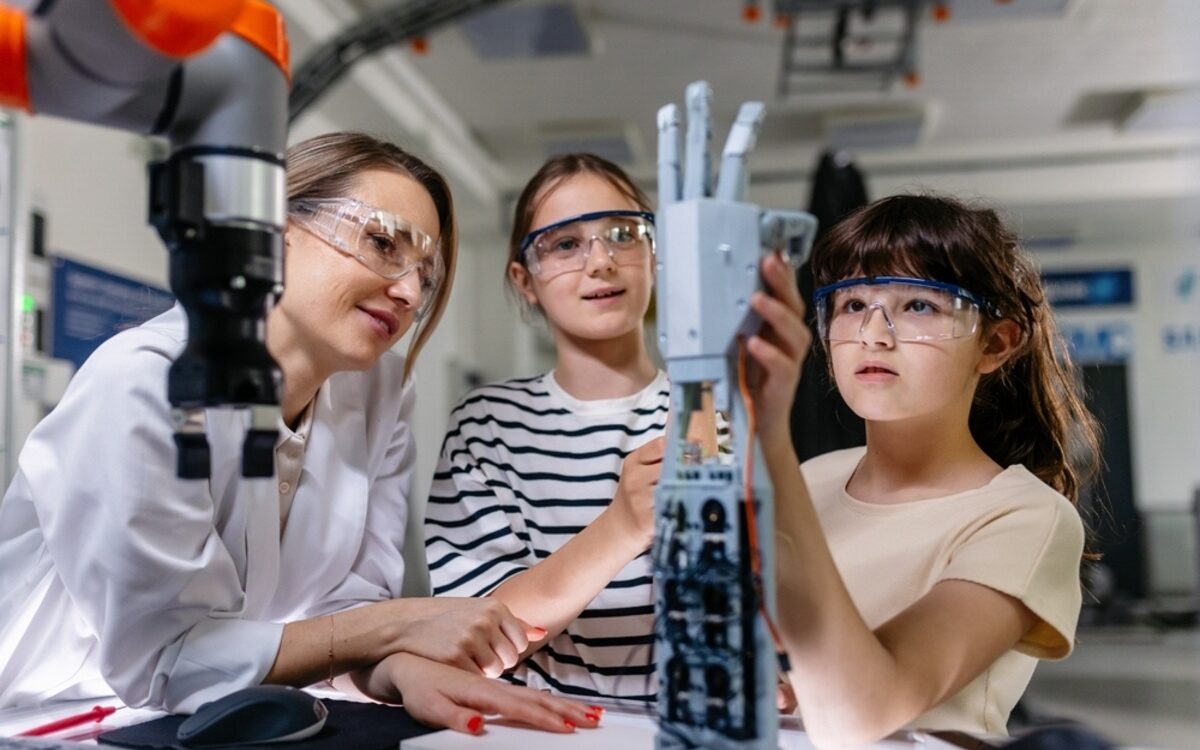
There is a significant difference between a child who has memorized the steps of the scientific method and one who has actually used it to answer a question they genuinely wanted answered. The second child understands the process at a deeper level because they experienced it.
Research from the Journal of Educational Psychology confirms that hands-on, applied learning leads to stronger long-term retention than passive instruction. When students build, test, fail, adjust, and try again, they internalize problem-solving as a process rather than a formula to recite.
This is why the format of STEM education matters as much as the content. Projects that connect to real scenarios measuring rainfall, designing a load-bearing structure, tracking patterns in data give children a mental framework they can draw on years later when they encounter similar challenges in adult life. Understanding STEM learning for students in this context makes it clear why applied formats produce stronger outcomes than textbook-only instruction.
STEM Skills and Social Development
It is worth noting that STEM education, done well, is rarely a solo activity. Group projects, peer reviews, and collaborative experiments teach children how to share responsibilities, listen to different perspectives, and resolve disagreements productively.
These social skills matter enormously in real-world settings. Most workplaces regardless of industry require people to work in teams, communicate across departments, and navigate disagreement without shutting down. Children who practice these dynamics in a structured academic environment are better prepared to handle them when the stakes are higher.
What Parents Can Do to Reinforce STEM Skills at Home
You do not need specialized equipment or a background in science to help your child build on what they are learning in school. Some of the most effective ways to reinforce STEM skills in the real world happen through ordinary daily activities:
- Cooking together — measuring ingredients, adjusting quantities, and observing chemical reactions all involve math and science
- Talking through decisions — when you explain your reasoning out loud, you model the kind of analytical thinking STEM education builds
- Encouraging questions — when a child asks how something works, taking time to explore the answer together builds curiosity and research habits
- Playing strategy games — chess, Sudoku, building games, and logic puzzles develop the same reasoning skills as formal STEM work
- Letting them troubleshoot — resist the urge to fix problems immediately; allowing a child to work through frustration builds the persistence that a strong STEM program demands
Frequently Asked Questions
No. STEM skills like problem solving, critical thinking, and data interpretation are valuable in every career path and in everyday life. Fields like business, healthcare, education, law, and the arts all benefit from analytical thinking and logical reasoning developed through STEM education.
STEM skill development begins earlier than most parents expect. Children as young as five start developing foundational skills like sorting, pattern recognition, and basic cause-and-effect reasoning. Formal STEM programs build on these natural tendencies from kindergarten onward.
Look for transfer. A child who can apply what they learned in one context to a different situation is developing genuine skills. If your child uses math reasoning to figure out a fair way to divide something at home, or asks why and then tries to test the answer, those are strong indicators.
There is some overlap, but STEM skills tend to emphasize applied, iterative problem solving over performance on a single correct answer. Academic skills often include memorization and recall, while STEM skills prioritize process, experimentation, and reasoning through uncertainty.
Yes. STEM education covers a wide range of subjects and skill types. A child who finds mathematics difficult may thrive in engineering design, scientific observation, or technology projects. Strong STEM programs meet students where they are and build confidence incrementally rather than filtering children out based on early math performance.
See How STEM Skills Come to Life in the Classroom
The skills children develop through STEM education are not confined to classrooms or careers in science. They shape how young people think, decide, communicate, and adapt long after they leave school. Problem solving, critical thinking, data reasoning, and persistence are among the most practical tools a child can carry into adulthood.
If you are thinking about what kind of education will genuinely prepare your child for the world ahead, understanding what STEM skills look like in practice is a good place to start.
Disclaimer
The information in this blog is intended for general educational purposes only. The STEM skills and real-world applications described are based on broadly recognized educational research and general knowledge. No specific academic outcomes, skill development timelines, or career results have been guaranteed or implied. External sources cited are referenced for informational purposes only. Parents are encouraged to speak directly with educators and visit schools to understand how STEM skills are developed within a specific learning environment.