Private School vs Homeschool: How Do You Know Which Is Right for Your Child?
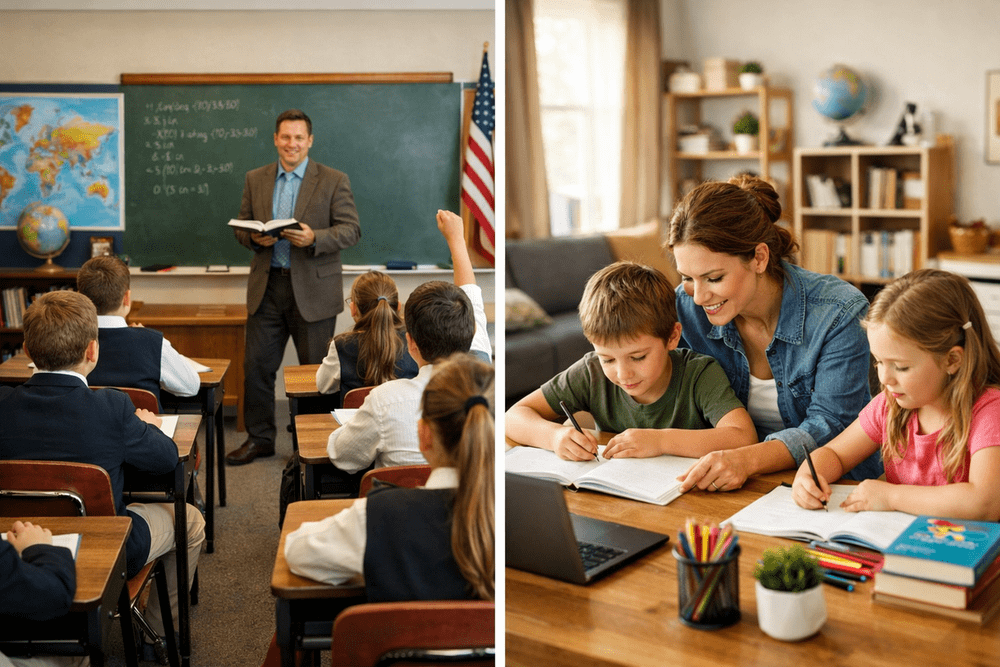
Private school vs homeschool is a comparison more families are making today than ever before. The number of children being homeschooled in the United States has grown steadily over the past decade, and the range of parents choosing this path has widened well beyond the groups most commonly associated with it historically.
At the same time, private schools have evolved significantly. Many now offer smaller class sizes, flexible pacing, project-based learning, and enrichment programming that addresses some of the specific reasons families have traditionally turned to homeschooling in the first place.
So how do you actually decide? This guide walks through the most important factors in the private school vs homeschool decision without assuming that one path is right for every family or every child.
What Homeschooling Offers That Parents Value Most
To make a fair comparison, it helps to start by taking homeschooling seriously on its own terms. Families who choose homeschooling most commonly cite the following reasons:
Individualized pacing. In a homeschool setting, a child who masters a concept quickly does not have to wait for the rest of a class to catch up. A child who needs more time on something can take it without feeling left behind. This level of customization is genuinely difficult to replicate in most group classroom settings.
Schedule flexibility. Homeschooled children can learn at the times of day when they are most alert, take breaks when they need them, and structure their week around family life, travel, and other experiences that contribute to their education.
Values alignment. Many parents choose homeschooling because they want direct control over the content their child is exposed to and the values framework within which learning takes place.
Freedom from standardized testing pressure. Homeschooled children are often not subject to the same testing schedules that shape public and some private school curricula, which allows for deeper exploration of topics that genuinely interest the child.
These are real advantages, and any honest comparison with private school has to acknowledge them.
What Private School Offers That Homeschooling Cannot Replicate
Private school brings a different and equally significant set of advantages. Some of the most important are the ones that are hardest to reproduce in a home setting.
Structured peer interaction. Learning alongside peers of similar age is not just a social benefit. It is a cognitive one. Children develop communication skills, perspective-taking, and the ability to collaborate under pressure through regular structured interaction with other students. This is difficult to replicate consistently in a homeschool environment, even with co-ops and extracurricular activities.
Specialist instruction. A private school can offer dedicated teachers for STEM, arts, music, physical education, and foreign language. Most parents, no matter how educated or committed, cannot match the depth of specialist knowledge across all of these areas over a full K-8 journey.
Institutional resources. Laboratory equipment, classroom libraries, sports facilities, performing arts spaces, and technology infrastructure are resources that most families cannot reasonably provide at home.
Accreditation and accountability. Private schools that hold accreditation from independent bodies like Cognia have had their curriculum, instruction, and student support systems reviewed against rigorous external standards. This provides families with a meaningful quality assurance that homeschooling cannot offer by definition.
Preparation for group learning environments. Middle school, high school, college, and virtually every workplace require people to function effectively in structured group settings. Students who have spent their formative years in an accredited private school typically transition into these environments with greater ease than those who have been educated primarily at home.
The Social Development Question
One of the most frequently debated aspects of the private school vs homeschool comparison is socialization. Advocates for homeschooling rightly point out that homeschooled children can and do develop strong social skills through community activities, sports, religious organizations, and homeschool co-ops.
However, the kind of social development that happens in a structured school setting is qualitatively different from what co-ops and community activities provide. In a private school classroom, children navigate disagreement with peers in real time, work in assigned groups where they do not get to choose their teammates, and develop relationships with adult authority figures outside their own family. These experiences build specific social competencies that are hard to replicate through self-directed socialization.
A strong private school also builds a sense of community and belonging that extends beyond academics. Students develop school pride, form lasting friendships, and experience the social rituals, performances, field trips, shared projects, celebrations that shape their identity as learners. Families comparing these options often find this dimension of private school education to be one of the most compelling factors in favor of an institutional setting.
When Homeschooling May Be the Better Choice
There are circumstances where homeschooling may genuinely be the better fit for a child or family, and it is worth naming them directly.
A child with significant medical needs, anxiety around group environments, or a learning profile that requires a level of individualization that even small private school classes cannot provide may thrive more in a home setting. A family with a highly mobile lifestyle, unusual work schedules, or educational philosophies that differ fundamentally from what any available school offers may find homeschooling more aligned with their circumstances.
The key is to make the decision based on the child’s specific needs and the family’s genuine capacity to deliver a rigorous, well-rounded education over many years, not based on frustration with a specific school or a generalized distrust of institutions.
When Private School Is the Stronger Choice
For most families, a high-quality private school provides a richer, more structured, and more reliably consistent education than homeschooling can offer. This is particularly true when the private school in question has strong STEM programming, arts integration, foreign language instruction, and a coherent curriculum that builds intentionally from kindergarten through eighth grade.
The presence of specialist teachers, accreditation, and a community of peers creates conditions for development that are genuinely difficult for a single household to replicate. For children who thrive in structured environments, benefit from peer interaction, and need the accountability that a formal school setting provides, private school is typically the stronger long-term choice.
Parents who want to evaluate these options honestly should spend time looking closely at the curriculum, visiting classrooms, and asking specific questions about how the school supports different kinds of learners. Understanding what sets private schools apart in terms of curriculum design and student support is essential to making a well-informed comparison.
What the Research Says
Research on outcomes for homeschooled versus privately schooled students is genuinely mixed, largely because both populations are internally diverse. Well-executed homeschooling by dedicated, educated parents can produce excellent outcomes. Well-designed private school education with strong curriculum and specialist instruction also produces excellent outcomes.
According to the National Home Education Research Institute, homeschooled students on average perform above grade level on standardized assessments. However, this finding reflects a population that is, on average, served by highly motivated, well-resourced parents with strong educational backgrounds. The average outcome for homeschooled students does not tell you what outcome a specific child will experience in a specific home setting.
The same caveat applies to private schools. Accreditation, curriculum quality, teacher expertise, and class size all vary. The comparison is most useful when it is specific rather than general.
Questions to Ask Before Making the Decision
Whether you are leaning toward private school or homeschooling, these questions can help clarify your thinking:
- What are my child’s specific social and learning needs, and which environment addresses them more directly?
- What is my realistic capacity to deliver specialist instruction across all academic areas for eight or more years?
- How does my child respond to group environments, structured schedules, and adult authority outside the home?
- What are the accreditation, curriculum quality, and student support resources of the private schools available to me?
- What does my child want, and how much does that matter at their current age?
Frequently Asked Questions
Yes. Homeschooling is legal in New York State, though it is subject to specific regulations including annual filing with the local school district, an approved curriculum plan, and standardized assessment requirements at certain grade levels. Parents considering homeschooling in New York should review the current state regulations carefully before beginning.
It depends significantly on the quality and structure of the homeschooling experience. Students who have had rigorous, well-documented homeschool education can transition successfully to high school and college. The transition tends to be more challenging when the homeschool experience has been inconsistent or lacked the structure and accountability that formal schooling provides.
Homeschooling offers the maximum possible individual attention by definition. However, private schools with small class sizes can come significantly closer to individualized instruction than public schools. The additional benefit private school provides is specialist expertise across subjects, structured peer interaction, and institutional resources that homeschooling cannot match.
Most private schools accept mid-year transfers, though placement decisions depend on the school’s current enrollment and the child’s academic profile. The transition is typically smoother when the homeschool record is well-documented and the child has been exposed to structured group learning in some form.
Look for small class sizes, a teacher-to-student ratio that allows for genuine individual attention, a flexible and responsive curriculum, and a school culture that values the kind of curiosity and independence that homeschooling often fosters. Choosing a private school that welcomes students from non-traditional educational backgrounds and has experience supporting diverse learning profiles will make the transition significantly easier.
Curious About What a Private School Environment Offers?
The private school vs homeschool decision is not one that has a single right answer. It depends on your child, your family, and the specific options available to you. What matters most is that the decision is made thoughtfully, based on honest assessment of your child’s needs and your family’s capacity to meet them over the long term.
For families who have access to a high-quality private school with strong curriculum, specialist instruction, and a supportive community, that setting typically offers advantages that are genuinely difficult to replicate at home.
Disclaimer
The information in this blog is intended for general educational purposes only. The comparisons between private school and homeschooling reflect general research and broadly observed patterns and do not constitute professional educational or legal advice. Homeschooling laws and regulations vary by state and are subject to change. Parents should consult their local school district and review current state regulations before making homeschooling decisions. No specific academic outcomes or enrollment results have been guaranteed or implied.