
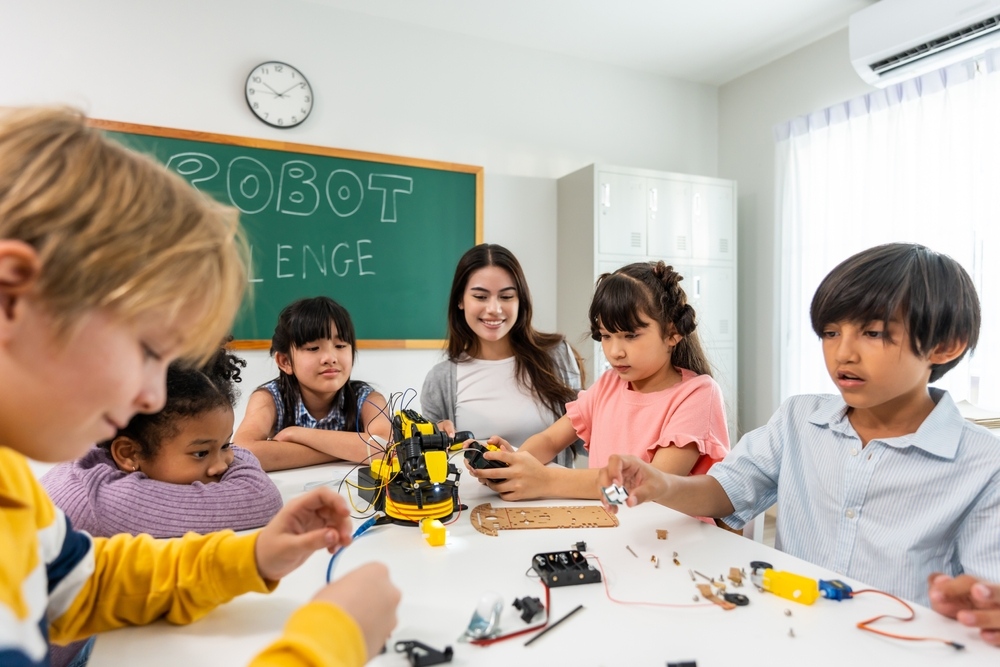
What Are STEM Projects for Elementary Students and Why Do They Matter?
STEM projects for elementary students are hands-on learning experiences that combine science, technology, engineering, and mathematics into a single, applied challenge. Rather than teaching each subject in isolation, these projects ask students to draw on multiple disciplines at the same time to design, build, test, and improve something real.
For parents who are new to the concept, it can be helpful to understand exactly what this looks like in practice, why educators consider it so effective, and what it means for a child’s long-term development. This guide answers those questions directly.
What STEM Projects for Elementary Students Actually Look Like
The term STEM project covers a wide range of learning experiences, and the format varies significantly depending on the age of the student and the goals of the program. At the elementary level, well-designed STEM projects share several common characteristics regardless of the specific topic.
They begin with a problem or question rather than a set of instructions. Students are asked to figure something out rather than replicate a procedure that has already been demonstrated. They involve planning, materials, and multiple attempts. They require students to document what they observe and explain what they learned. And they typically involve working with at least one other person.
Some examples of STEM projects for elementary students that reflect these principles include:
- Designing and testing a structure that can hold a specified amount of weight using limited materials
- Building a simple circuit and exploring how changes to the circuit affect the outcome
- Creating a model that demonstrates a natural process such as erosion, water filtration, or plant growth
- Coding a simple sequence of instructions to move a character through a problem
- Designing a solution to a real-world challenge such as reducing food waste, improving water access, or building a stronger package
Each of these projects asks students to think like engineers and scientists rather than simply follow along with a teacher’s demonstration. The difference in cognitive engagement is significant.
Why STEM Projects Produce Deeper Learning Than Textbook Instruction
When a child reads about how a bridge holds weight, they gain information. When they design a bridge, test it, watch it fail, identify why, and rebuild it, they gain understanding. These are fundamentally different outcomes, and they are not equally valuable.
Research from the National Science Teaching Association consistently supports project-based approaches as more effective than passive instruction for developing long-term retention, scientific reasoning, and motivation to learn. The reason is not complicated. When students are genuinely invested in solving a problem they have defined, the learning that follows is connected to experience rather than memorization. That kind of learning is far more durable.
STEM projects for elementary students also develop skills that textbook instruction rarely addresses directly. Students practice planning under constraints, communicating their ideas to peers, managing disagreement within a group, and persisting through repeated failure. These are not soft extras. They are the competencies that research consistently identifies as predictive of long-term academic and professional success. Exploring hands-on STEM programs that center this kind of project-based experience helps parents understand what quality STEM instruction looks like in practice.
How STEM Projects Build Skills Across Multiple Subjects
One of the most practical benefits of STEM projects for elementary students is that they develop skills across multiple academic areas simultaneously. A single well-designed project can strengthen mathematical reasoning, scientific observation, written communication, and collaborative skills all at once.
Consider a project in which students design and test a water filtration system using common materials. In the course of completing this project, students:
- Apply mathematical thinking by measuring volumes and comparing results
- Practice scientific reasoning by forming hypotheses and evaluating evidence
- Develop communication skills by writing up their procedure and presenting their findings
- Build technological understanding by analyzing how filtration systems work in real-world applications
- Strengthen engineering habits by identifying weaknesses in their design and proposing improvements
That level of integrated skill development is difficult to achieve through four separate subject periods. It is one of the defining strengths of a curriculum that takes STEM projects seriously as a learning format rather than treating them as occasional enrichment activities.
What Good STEM Project Facilitation Looks Like
The quality of a STEM project depends enormously on how it is facilitated. A project that is too structured becomes a recipe-following exercise that produces correct results without producing genuine thinking. A project that is too open-ended without enough guidance leaves students without the scaffolding they need to make progress.
Effective facilitation strikes a balance. Teachers who facilitate STEM projects well ask questions rather than giving answers. They create conditions where failure is treated as information rather than as a problem to avoid. They help students articulate what they are observing and why it matters without telling them what to conclude. And they ensure that the documentation and reflection that follow a project are treated with the same seriousness as the hands-on activity itself.
This kind of teaching requires both subject knowledge and pedagogical skill. It is one reason why the quality of teachers in a STEM program matters as much as the quality of the materials and projects themselves.
How STEM Projects Connect to Social and Emotional Development
Parents sometimes focus exclusively on the academic dimensions of STEM projects and overlook their contribution to social and emotional development. The two are more connected than they might appear.
When students work together on an open-ended project with no single correct answer, they encounter genuine disagreement. One student wants to try one approach, another student wants to try something different. The group has to decide, test, and evaluate together. These are not easy dynamics to navigate, and they do not resolve themselves automatically. Students who practice navigating them in a structured, supportive classroom environment build social skills that carry forward into every group situation they will face in their lives.
The emotional component is equally important. A child who experiences the frustration of a failed design and chooses to try again rather than give up is building something that psychologists call persistence or grit. Research from the American Psychological Association identifies this quality as one of the strongest predictors of long-term achievement, more reliable in many contexts than raw ability or early academic performance.
What Parents Can Look for When Evaluating a School's STEM Projects
Not all STEM programs are designed equally, and the label does not guarantee quality. When evaluating whether a school’s approach to STEM projects for elementary students is genuinely effective, here are the most important things to look for:
- Open-ended design. Projects should have multiple valid approaches, not a single correct procedure to follow.
- Student ownership. Students should be making meaningful decisions about their design, not simply executing instructions.
- Documented process. Students should be recording their observations, hypotheses, and revisions throughout the project, not just at the end.
- Reflection built in. Time for discussion and reflection after a project is as important as the hands-on activity itself.
- Connection to real problems. The best projects connect to something that exists in the real world, giving students a reason to care about the outcome.
A school that can describe its STEM projects in these specific terms, and that can show you examples of student work from completed projects, is one that has invested seriously in this approach. Learning more about STEM education for kids within a structured program helps parents identify what genuine quality looks like.
How STEM Projects Evolve Across the Elementary Years
STEM projects for elementary students do not look the same in kindergarten as they do in fifth or sixth grade. A well-designed K-8 program scaffolds project complexity intentionally across the years so that each stage builds on what came before.
In the early years, projects tend to be shorter in duration, more concrete in materials, and more heavily guided by the teacher. The goal is to introduce the habits of mind that STEM projects develop: asking questions, making observations, trying something, and talking about what happened.
By the middle elementary years, projects become more complex and more student-directed. Students are expected to plan more independently, work through longer timelines, and produce more detailed documentation of their process. The teacher’s role shifts from guide to facilitator.
By the upper elementary and middle school years, projects may extend over several weeks, involve genuine research and data collection, and require formal presentation of findings to an audience beyond the classroom. At this level, STEM projects for elementary and middle school students begin to resemble real professional workflows in meaningful ways.
Understanding this developmental arc helps parents see why consistent exposure to STEM learning from the earliest grades matters so much. The skills built in kindergarten become the platform for everything that follows.
Frequently Asked Questions
Project duration varies widely depending on the age of the students and the complexity of the challenge. Simple projects in early elementary may take a single class period. More complex engineering or science challenges in upper elementary may span several days or weeks, including planning, building, testing, revision, and presentation phases.
No. STEM projects complement and deepen traditional instruction rather than replacing it. Students need foundational knowledge in science and mathematics to engage effectively with project-based challenges. The most effective programs integrate both, using direct instruction to build knowledge and projects to develop the ability to apply it.
Yes. Many schools offer a mix of individual and group project formats. Even within group projects, students often have defined individual roles that allow for independent contribution. The social dimensions of group STEM projects are also developmentally important, and students who initially resist collaborative work often develop more comfort with it over time through repeated supported practice.
Ask your child to explain what they are working on and why. Resist the urge to help them solve problems before they have had a chance to work through them independently. Provide materials for informal experimentation at home when interest arises. And treat questions without immediate answers as opportunities to explore together rather than problems to solve quickly.
A science fair project typically follows a defined format including a hypothesis, controlled experiment, data collection, and conclusion. STEM projects are broader and often involve engineering design, technology, or mathematical modeling in addition to scientific inquiry. Both are valuable, but STEM projects tend to be more open-ended and collaborative than the traditional science fair format.
See How Students Work Through Real STEM Projects Every Day
STEM projects for elementary students do more than teach science and math concepts. They build the habits of mind, social skills, and emotional resilience that carry children forward across every area of their education and their lives. The quality of these projects, and the quality of the teaching that supports them, matters enormously for how much students actually develop through the experience.
Disclaimer
The information in this blog is intended for general educational purposes only. The learning approaches and outcomes described are based on broadly recognized educational research and general knowledge of STEM pedagogy. No specific academic outcomes, skill development timelines, or results have been guaranteed or implied. External sources cited are referenced for informational purposes only. Parents are encouraged to speak directly with educators and visit schools to understand how STEM projects are implemented within a specific program.
References
National Science Teaching Association. (2024). Science and Children: NSTA’s peer-reviewed practitioner journal for elementary-level science teachers. https://www.nsta.org/science-and-children
American Psychological Association. (2024). Developmental Psychology. APA Journals. https://www.apa.org/pubs/journals/dev