
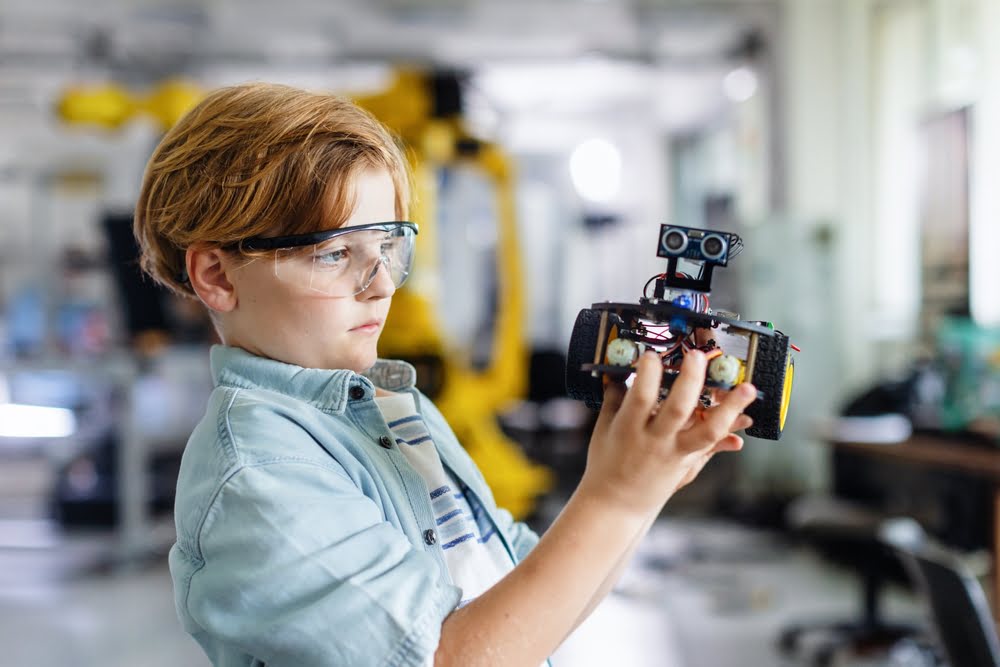
How STEM Builds Critical Thinking Skills That Last a Lifetime
- Alex Marchuk
- June 07, 2026
- 10 min read
STEM
Table of Contents
- 1. What Critical Thinking Means in STEM Education
- 2. How STEM Critical Thinking Differs From General Academic Reasoning
- 3. The Four Core Components of STEM Critical Thinking
- 4. How Critical Thinking Develops Across the Elementary Years
- 5. Why Open-Ended Problems Are the Primary Vehicle for Critical Thinking
- 6. How Parents Can Reinforce Critical Thinking at Home
- 7. What to Look for in a School That Develops Critical Thinking Through STEM
- 8. Frequently Asked Questions
- 9. References
STEM critical thinking skills are among the most durable and transferable abilities a child can develop during their elementary years. While the term critical thinking is widely used in education, it is rarely defined precisely enough to be useful. This blog explores what critical thinking actually means in the context of STEM education, how it develops across the elementary grades, and why parents should treat it as one of the most important outcomes of a quality K-8 program.
1. What Critical Thinking Means in STEM Education
Critical thinking in the context of STEM education is the ability to analyze information, question assumptions, evaluate evidence, and reach reasoned conclusions. It is not the same as being smart or knowing a lot. It is a set of cognitive habits that allow a person to engage productively with problems that do not have obvious answers.
In a STEM classroom, critical thinking shows up when a student asks why an experiment produced an unexpected result rather than simply recording what happened. It shows up when a student evaluates two different design approaches and can articulate the trade-offs rather than defaulting to the first idea. It shows up when a student recognizes that a claim requires evidence and asks what evidence would actually support it.
These are not advanced skills reserved for older students. The foundations of STEM critical thinking are built from the earliest years of elementary school, and the habits formed in those years shape how a child approaches problems for the rest of their life. Understanding what hands-on STEM programs look like in practice helps parents recognize the difference between programs that develop genuine critical thinking and those that teach procedures without promoting independent reasoning.
2. How STEM Critical Thinking Differs From General Academic Reasoning
Academic reasoning, as traditionally taught, tends to focus on applying a known method to a defined problem with a correct answer. A student who is strong in academic reasoning can follow an algorithm, recall the right formula, and reproduce a learned procedure accurately.
STEM critical thinking requires something additional. It requires the ability to work productively in situations where the method is not obvious, the answer is not known, and the path forward has to be constructed rather than retrieved. This distinction matters enormously for how children are prepared for adult life.
Most of the problems that matter in adult life, whether professional, financial, social, or civic, do not come with instruction manuals. They require exactly the kind of reasoning that STEM education develops: the ability to define a problem clearly, generate possible approaches, evaluate them against evidence, and revise based on what is discovered. A child who graduates from a quality K-8 program with strong STEM critical thinking skills is better equipped for this kind of work than one who has only developed strong procedural academic skills.
3. The Four Core Components of STEM Critical Thinking
While critical thinking is sometimes discussed as a single skill, it is more accurately understood as a cluster of related abilities that develop together and reinforce each other.
Analysis. The ability to break a complex situation into its component parts, identify relationships between those parts, and understand how a change in one part affects the whole. In STEM education, analysis develops through experiments that require students to isolate variables and through engineering challenges that require them to evaluate how structural choices affect performance.
Evaluation. The ability to assess the quality, relevance, and reliability of information before acting on it. In STEM education, evaluation develops through activities that require students to compare data from multiple trials, assess whether a design meets its stated criteria, and decide which of several approaches is most likely to succeed.
Inference. The ability to draw reasonable conclusions from available evidence without overstating what the evidence actually supports. In STEM education, inference develops through scientific investigations where students must distinguish between what their data shows and what it does not show.
Problem formulation. The ability to define a problem clearly and precisely before attempting to solve it. Many adults struggle with this skill because school rarely teaches it explicitly. STEM programs that begin projects with a problem-definition phase, where students articulate exactly what they are trying to achieve and what constraints apply, develop this ability directly.
4. How Critical Thinking Develops Across the Elementary Years
STEM critical thinking does not emerge fully formed. It develops incrementally across the elementary years, and each stage builds on what came before. A well-designed K-8 STEM program scaffolds this development intentionally.
In kindergarten and first grade, the focus is on observation and questioning. Students learn to notice carefully, describe accurately, and ask why. The emphasis is on curiosity and the habit of looking more closely rather than accepting the first impression.
In second and third grade, students begin working with simple cause-and-effect reasoning. They design basic experiments, make predictions, and compare what they expected with what they observed. The concept of evidence as distinct from opinion begins to take shape.
In fourth and fifth grade, students engage with more complex design challenges that require planning, iteration, and evaluation. They learn to articulate trade-offs, recognize that there are multiple valid approaches to most problems, and defend their choices with reasoning rather than preference.
In sixth through eighth grade, students apply critical thinking to multi-variable problems, longer-term projects, and genuine research questions. They produce work that requires sustained reasoning, careful documentation, and the ability to communicate findings clearly and precisely to an audience beyond the classroom.
This developmental arc is one of the strongest arguments for consistent engagement with STEM education for kids from the earliest grades rather than introducing it only in upper elementary or middle school.
5. Why Open-Ended Problems Are the Primary Vehicle for Critical Thinking
Critical thinking cannot be developed through instruction alone. It requires practice in situations that actually demand it. This is why open-ended problems are the primary vehicle for building STEM critical thinking skills.
A closed problem, meaning one with a single correct answer reached by a known method, does not require critical thinking. It requires recall and procedure. An open-ended problem, meaning one where the answer is not predetermined and multiple valid approaches exist, requires exactly the kind of analysis, evaluation, and inference that critical thinking involves.
According to research published by the American Educational Research Association, students who regularly engage with open-ended problems develop stronger metacognitive skills than those whose learning is primarily procedural. Metacognition, the ability to think about one’s own thinking, is one of the most powerful predictors of long-term academic success because it allows students to monitor their own understanding and adjust their approach when something is not working.
Private schools that prioritize open-ended STEM challenges as a core part of their curriculum are not simply enriching the academic experience. They are building the cognitive infrastructure that critical thinking requires. Families exploring what sets private schools apart in terms of curriculum design often find this commitment to open-ended learning to be one of the most meaningful differentiators.
6. How Parents Can Reinforce Critical Thinking at Home
The habits of critical thinking that STEM education builds in the classroom can be reinforced at home through ordinary conversations and everyday situations. You do not need special materials or a science background to support this development.
Some practical approaches that make a genuine difference:
- Ask evaluative questions rather than factual ones. Instead of asking what happened, ask what do you think caused that, and what else could explain it.
- Model uncertainty openly. When you do not know something, say so and demonstrate looking it up rather than guessing. Children who see adults acknowledge the limits of their knowledge develop a healthier relationship with not knowing.
- Slow down decision-making conversations. When your family faces a choice, walk through the reasoning out loud. What are the options? What would each one cost or require? What matters most? This models exactly the kind of structured evaluation that STEM critical thinking involves.
- Encourage your child to change their mind based on evidence. A child who receives new information and updates their position is demonstrating strong critical thinking. Praise this explicitly rather than treating it as inconsistency.
- Resist settling disagreements by authority alone. When your child challenges something you have said, engage with the challenge rather than simply asserting parental authority. This teaches them that claims require support regardless of who is making them.
7. What to Look for in a School That Develops Critical Thinking Through STEM
Not all STEM programs develop critical thinking equally, and the label does not guarantee the substance. When evaluating a school’s approach, look for specific evidence rather than general claims.
Ask to see examples of student work from completed STEM projects. Work that demonstrates genuine critical thinking will show evidence of multiple approaches considered, revision based on results, and reasoning that goes beyond describing what was done to explaining why decisions were made.
Ask how the school assesses critical thinking. A school that assesses students exclusively through tests and correct-answer formats is not measuring or developing critical thinking in a meaningful way. Look for assessment formats that reward the quality of reasoning, not just the accuracy of the conclusion.
Ask what happens when a student’s approach fails. A school where failure is treated as a learning opportunity and where students are expected to analyze what went wrong and try again is developing critical thinking. A school where failure is treated as a problem to avoid is not.
8. Frequently Asked Questions
Both elements are necessary. Direct instruction in reasoning strategies, such as how to evaluate evidence, how to identify assumptions, and how to construct a logical argument, provides students with tools they can apply. But these tools only develop into genuine habits through repeated practice in situations that require them. The most effective STEM programs provide both explicit instruction and sustained open-ended practice.
The foundations of critical thinking, including the ability to notice, question, and reason about cause and effect, begin developing in the earliest years of school and even before. The sophistication of critical thinking grows steadily through elementary and middle school as students encounter increasingly complex problems. There is no age at which critical thinking begins. There is only the question of whether the environment is providing the experiences that allow it to develop.
Yes, and it is well-documented. The analytical and evaluative habits developed through STEM education transfer directly to reading comprehension, writing argumentation, historical analysis, and other non-STEM domains. Critical thinking is not subject-specific. It is a set of cognitive habits that improves performance wherever careful reasoning matters.
Look for transfer. A child who applies reasoning learned in one context to a genuinely different situation is demonstrating critical thinking. Other signs include asking follow-up questions rather than accepting the first answer, noticing when something does not add up, revising their views based on new information, and being able to explain not just what they concluded but why.
It can, particularly when the private school has the curriculum flexibility to implement open-ended STEM challenges without the constraints of standardized testing timelines. Private schools that invest in specialist STEM teachers and project-based learning formats typically provide more consistent opportunities for critical thinking development than settings where curriculum is tightly constrained by external testing requirements. The benefits of private school for critical thinking development are most significant in environments that treat open-ended problem solving as a core academic priority rather than an occasional enrichment activity.
Key Takeaways
STEM critical thinking skills are not a single ability but a cluster of related cognitive habits including analysis, evaluation, inference, and problem formulation that develop incrementally across the elementary years. These habits are built primarily through open-ended problems that require genuine reasoning rather than procedural recall. The development of critical thinking through STEM is not limited to science and math. It transfers across all academic domains and into the practical challenges of adult life. A school that is serious about building critical thinking will show evidence of it in student work, assessment formats, and the way it responds to failure and revision. Parents who want to support this development at home can do so through everyday conversation and by modeling the kind of evaluative reasoning that STEM education builds in the classroom.
Ready to See Critical Thinking Happen in Real Time?
STEM critical thinking skills are among the most valuable things a quality elementary education can build. They shape how children approach problems, evaluate information, and adapt to new challenges for the rest of their lives. If you are evaluating schools for your child, understanding how a program develops critical thinking is one of the most important questions you can ask.
Schedule a visit and see how students work through open-ended challenges, revise their thinking, and build the reasoning habits that carry them forward.
Disclaimer: The information in this blog is intended for general educational purposes only. The learning approaches and outcomes described are based on broadly recognized educational research and general knowledge of STEM pedagogy. No specific academic outcomes, skill development timelines, or results have been guaranteed or implied. External sources cited are referenced for informational purposes only. Parents are encouraged to speak directly with educators and visit schools to understand how critical thinking is developed within a specific program.
References:
- American Educational Research Association. Publications and Journals. https://www.aera.net/Publications/Journals
- National Science Teaching Association. Science and Children. https://www.nsta.org/science-and-children