What Is Play-Based STEM Learning and How Does It Work?
- Alex Marchuk
- July 5, 2026
- 10 min read
STEM
Table of Contents
- 1. What Is Play-Based STEM Learning?
- 2. How Play-Based STEM Learning Works in the Classroom
- 3. Why Play Matters for STEM Skills
- 4. Examples of Play-Based STEM Activities
- 5. Skills This Approach Builds Beyond Academics
- 6. What Research Says About Play and STEM
- 7. How This Compares to Traditional STEM Instruction
- 8. Bringing This Into Everyday Moments at Home
- 9. FAQ
- 10. See This Approach in a Real Classroom
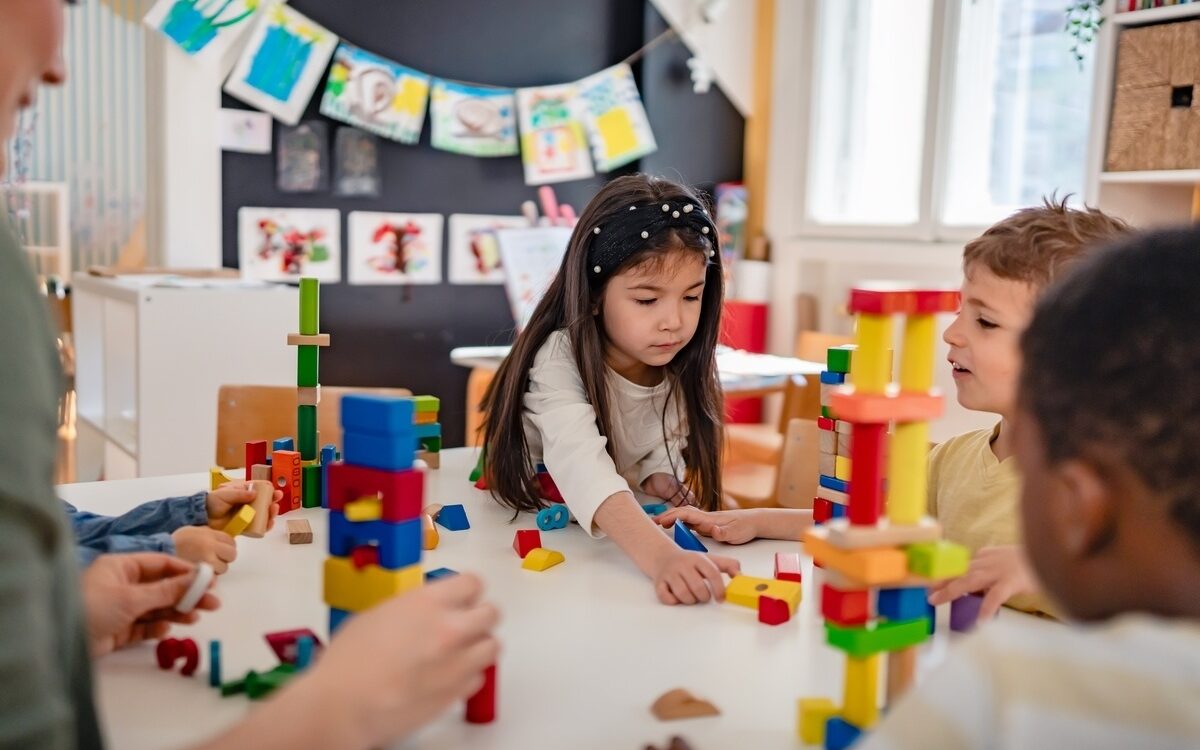
If you have ever watched a child stack blocks, build a fort, or test which toy floats in water, you have already seen play-based STEM learning in action. It is not a formal lesson. It is not a worksheet. It is simply play, guided with intention.
You have probably also seen the term used loosely in school brochures and program descriptions, even when the daily reality looks nothing like real play. That gap between the label and what actually happens in a classroom is exactly what confuses parents trying to compare programs. Knowing what this looks like in practice helps you tell the difference before you enroll.
This guide explains what this approach actually is, how it works in a classroom, and why it matters for young children.
1. What Is Play-Based STEM Learning?
Play-based STEM learning means teaching science, technology, engineering, and math through hands-on play instead of direct instruction. A child builds a tower and learns about balance. A child mixes colors and learns about chemistry. The learning happens through the play itself, not through a lecture about it.
This approach works because young children learn best through direct, physical experience. They are not ready to sit still and absorb facts. They need to touch, move, and test ideas with their hands.
2. How Play-Based STEM Learning Works in the Classroom
In a classroom that uses this method, teachers set up the environment first. They place blocks, water tables, ramps, and simple tools where children can reach them. Then they step back and let children explore.
A teacher’s role is not to lecture. It is to ask good questions. If a child is stacking blocks, a teacher might ask, “What do you think will happen if you add one more?” This small question turns simple play into real STEM thinking.
This kind of learning also happens in small, everyday moments. Getting dressed for outdoor play can turn into a talk about weather. Walking down a hallway can turn into noticing patterns in the floor tiles. According to ZERO TO THREE, even simple routines like mealtime and cleanup offer natural chances to build early math and science skills.
3. Why Play Matters for STEM Skills
Play matters because it is how young children are wired to learn. A child who is playing is fully engaged. Their brain is active, curious, and open to new ideas. This is very different from a child who is told to sit quietly and listen.
According to the American Academy of Pediatrics, play is not frivolous. It builds brain structure, supports problem-solving, and helps children manage stress. Play also strengthens the bond between a child and the adults who play with them.
When it is done well, children do not realize they are learning. They think they are just having fun. This is exactly the point. Children who enjoy STEM early on are more likely to feel confident with it later.
4. Examples of Play-Based STEM Activities
There are countless ways to bring play-based STEM learning into a classroom or home. A few common examples include:
- Building bridges out of blocks or cardboard and testing how much weight they can hold before they fall. Children adjust their design after each test, which builds early engineering thinking.
- Mixing colors or safe household materials to observe simple chemical reactions. Watching two colors blend into a new one is a child’s first real chemistry lesson.
- Planting seeds and tracking how they grow over several weeks. This teaches patience along with basic biology, since results take time to appear.
- Testing which objects float or sink in a bin of water. Children form a guess first, then test it, which mirrors the same process real scientists use.
- Sorting items by size, shape, or color to build early math thinking. This simple task lays the groundwork for later skills like counting and comparing.
None of these activities require special equipment. Many use materials that are already sitting around a classroom or home.
5. Skills This Approach Builds Beyond Academics
This approach also builds skills that go beyond academics. Children working on a shared project, like a block tower or a group experiment, learn to take turns, share ideas, and handle disagreement. These are social skills that matter well beyond any single lesson.
Language grows through this kind of play as well. A child describing why their tower fell, or explaining what they noticed when mixing colors, is practicing vocabulary and clear communication at the same time. Teachers who ask open-ended questions during play give children more chances to think out loud.
Confidence is another benefit that is easy to overlook. A child who tries an idea, watches it fail, and tries again without giving up is building resilience. This matters in school and in life far beyond any single STEM activity.
6. What Research Says About Play and STEM
STEM education, according to the National Science Foundation, is meant to build both a strong technical workforce and a scientifically literate public. That foundation starts far earlier than most people expect. Toddlers and preschoolers are already capable of real scientific thinking.
This connects directly to how STEM builds critical thinking skills that last a lifetime, since the habit of testing an idea and adjusting it starts with play long before a child ever sits at a school desk.
Research backs this up. Studies on early math skills show they strongly predict later success in both math and reading. Children who build a positive relationship with STEM early are more likely to keep that confidence as they get older.
This matters most in the earliest years, before a child ever sets foot in a formal classroom. Some children pick up early messages about who math and science are supposedly “for.” Joyful, hands-on exposure during the toddler and preschool years can shift that story in a healthier direction, well before those early impressions have time to settle in.
7. How This Compares to Traditional STEM Instruction
Traditional STEM instruction often looks like a lesson plan. A teacher explains a concept, then students complete a worksheet or a set exercise. Play-based STEM learning flips that order, letting children explore first.
Neither method is entirely right or wrong on its own. Many strong programs blend both. Younger children usually benefit more from open-ended play, while older students can handle more structured lessons layered on top of that same curious mindset.
The clearest sign of a genuine program like this is flexibility. Children are given real choices about what to build, test, or explore. A program that only follows a fixed script from start to finish is not truly play-based, even if it uses the same materials.
Age plays a real role in how this balance should look. A three-year-old benefits most from wide-open exploration with very little structure and almost no formal direction from an adult. By the time a child reaches upper elementary school, a bit more structure can actually help them go deeper into a topic instead of only skimming the surface.
The goal is not to remove structure entirely as children get older. It is to keep enough open-ended choice in place that curiosity still leads the way, even as lessons become more focused.
8. Bringing This Into Everyday Moments at Home
This kind of learning does not need to stay inside a classroom. Parents can bring it into daily life in small ways. Cooking together can turn into a lesson about measurement. A walk outside can turn into a conversation about weather or shadows.
This kind of everyday learning connects naturally to the approach used in this STEM program in Brooklyn, NY, where hands-on exploration is built into daily routines rather than treated as a separate subject.
Families who want to see how play and STEM fit into a broader curriculum can also look at the full range of programs offered, since play-based learning often works best alongside other subjects.
Getting started with play-based STEM learning at home does not require a big plan. A few small habits make the biggest difference over time.
- Ask questions instead of giving answers. When a child notices something odd, like a shadow changing shape, ask what they think caused it instead of explaining right away.
- Keep a few open-ended materials on hand. Blocks, cups, paper, and tape can support dozens of different builds and tests.
- Let mistakes happen. A tower that falls or a boat that sinks is not a failure. It is useful information a child can use to try again.
- Follow the child’s interest. If a child is fascinated by puddles, build a short activity around water instead.
These habits work just as well in a car ride, a kitchen, or a backyard as they do in a classroom, since this approach depends more on the adult’s mindset than on the setting itself.
9. FAQ
It means teaching science, technology, engineering, and math through hands-on play rather than direct lessons. Children build, test, and explore, and the learning happens naturally through that process.
It works especially well for toddlers and preschoolers, since they learn best through physical experience. Elements of it can still work for older children, often blended with more structured lessons.
No. Everyday items like blocks, water, sand, and household objects work well. What matters most is the questions asked during play, not the materials used.
Free play has no direction at all. This approach still involves free exploration, but an adult occasionally asks guiding questions or introduces a small challenge.
Yes. Everyday moments like cooking, walking outside, or cleaning up toys can become simple STEM lessons with the right kind of question from an adult.
Ask how much choice children actually have during activities. A genuine program lets children explore and test their own ideas, rather than following the same fixed steps every time.
10. See This Approach in a Real Classroom
Play-based STEM learning is not a trend. It reflects how young children are naturally wired to understand the world. Building, testing, and exploring through play gives children a real foundation in STEM thinking long before they ever sit through a formal lesson.
Choosing a program built around genuine play-based STEM learning, rather than one that only borrows the language for marketing, makes a real difference in how a child experiences science and math for the first time. The strongest programs give children real choices, real materials, and real time to test their own ideas instead of following the same fixed steps every day.
Key Takeaways
- Play-based STEM learning teaches science, technology, engineering, and math through hands-on exploration instead of direct instruction
- It works especially well for toddlers and preschoolers, who learn best through physical, hands-on experience
- Everyday items and routines, not special kits, are often enough to support this kind of learning
- The clearest sign of a genuine program is real choice, not a fixed script children must follow every time
SEE PLAY-BASED STEM LEARNING IN ACTION.
Seeing this approach in a real classroom is the best way to understand how it actually works day to day.
Disclaimer: The information in this blog is intended for general educational purposes only. Curriculum structures and terminology vary between schools. No specific academic outcomes have been stated or implied.
References
- American Academy of Pediatrics. (2018). Want creative, curious, healthier children with 21st century skills? Let them play. HealthyChildren.org. https://www.healthychildren.org/English/news/Pages/healthier-children-play-according-to-the-AAP.aspx
- National Science Foundation. (2026). Directorate for STEM Education (EDU). https://www.nsf.gov/edu
- ZERO TO THREE. (2024). Toddlers and STEM skills: How starting early benefits all students. https://www.zerotothree.org/resource/stem-activities-for-toddlers/